Finding the China best AI toys manufacturers for global buyers requires more than comparing factory prices. A reliable supplier must combine product creativity, engineering experience, stable production, and responsible business practices. This guide examines manufacturers through practical buyer concerns, including safety testing, software reliability, customization, communication, and export support.
AI toys should feel engaging, but they must also work consistently in real homes and classrooms. A talking robot that loses connection after ten minutes is not a strong product. Neither is a learning toy with unclear age guidance, weak battery protection, or poorly explained data practices. We will consider factory capabilities, prototype quality, material control, packaging details, and after-sales response. Sample testing matters.
Look beyond polished websites.
Global buyers should request current certifications, test reports, production photographs, and clear answers about firmware updates. They should also confirm whether the manufacturer manages development internally or outsources critical work. That difference can affect quality, timelines, and accountability. Experience with international shipments is useful, but it does not guarantee every order will be smooth. Even established suppliers can face communication gaps, component shortages, or changing platform requirements.
This comparison aims to provide a practical starting point, not a permanent ranking. Manufacturer strengths can change quickly. Our evaluation may also miss smaller factories with valuable specialist skills. Buyers should verify every claim independently and test products before committing to volume orders. The strongest partnership usually develops through transparent discussions, documented specifications, realistic expectations, and steady quality checks from concept to delivery.
What Defines a Reliable AI Toy Manufacturer in China
China Best AI Toys Manufacturers for Global Buyers?
What Defines a Reliable AI Toy Manufacturer in China
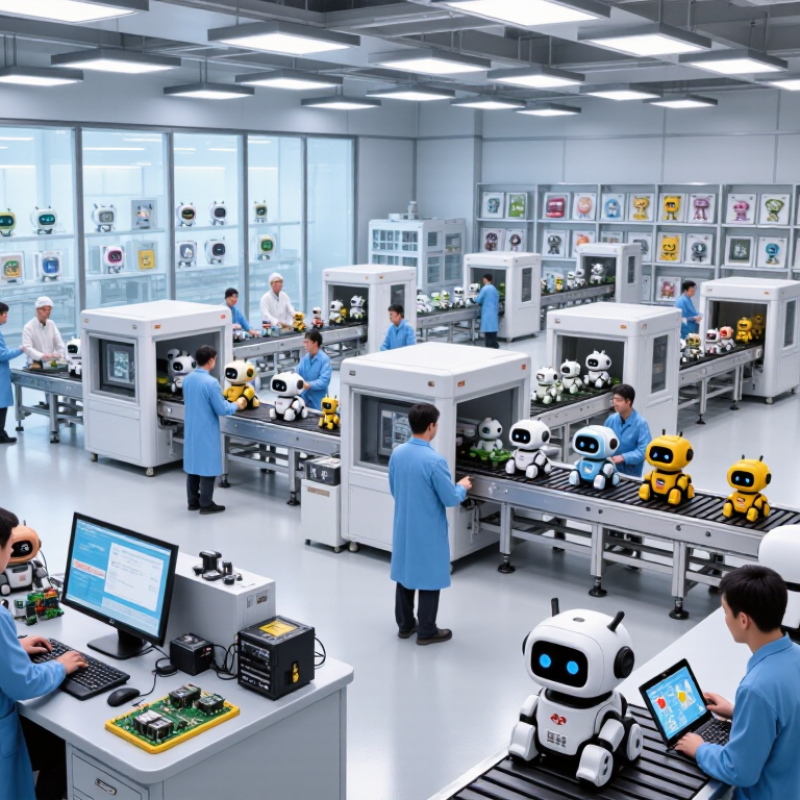
A reliable AI toy manufacturer provides evidence, not polished promises. During supplier evaluations, buyers should request factory photos, production records, and recent quality reports. An experienced manufacturer explains how microphones, speakers, sensors, and rechargeable batteries are tested. It should also provide clear specifications for materials, age guidance, and operating limits.
Look for controlled assembly lines and documented inspections. A strong quality team checks voice response, moving parts, charging safety, and package durability. Sample testing matters. One attractive prototype proves very little. Ask for several samples from different production batches. Differences can reveal weak process control. No factory is flawless. Honest communication matters more than perfect claims.
Data handling deserves equal attention. AI toys may process voice commands or connect with mobile applications. The manufacturer should explain storage, deletion, access controls, and software updates in plain language. It should support applicable safety and privacy requirements for each target market. Reliable suppliers also offer traceable components, stable lead times, and responsive after-sales support. A named contact should handle defects with photographs, replacement plans, and realistic deadlines. Sometimes a cheaper quotation hides thinner testing. That lesson is easy to forget. Clear records make the difference.
China Best AI Toys Manufacturers for Global Buyers? - What Defines a Reliable AI Toy Manufacturer in China
Practical evaluation framework for international buyers. The benchmarks below are buyer-oriented reference points and should be verified through factory records, product samples, laboratory reports, and contractual documentation.
| Evaluation Dimension | Recommended Buyer Benchmark | Why It Matters | |
|---|---|---|---|
| Product Safety Compliance | Compliance plan covering the destination market, including applicable toy, electrical, chemical, and battery requirements. | Current test reports from an accredited laboratory; technical file; bill of materials; risk assessment; production sample matching the tested configuration. | AI toys combine mechanical parts, electronics, software, speakers, microphones, and batteries, creating more compliance risks than conventional toys. |
| Relevant Toy Standards | Testing aligned with the requirements applicable to the sales region, such as ASTM F963 for the United States, EN 71 for the European market, or ISO 8124 where applicable. | Test reports that identify the exact model, revision, sample quantity, test date, and applicable clauses; no unexplained mismatch between the report and production model. | Verifies mechanical, physical, flammability, migration, and other toy-safety controls required by the target market. |
| Chemical and Material Control | Documented controls for restricted substances, coatings, plastics, adhesives, soft parts, and printed materials. | Material declarations, supplier certificates, restricted-substance testing, and batch traceability for high-risk materials. | Helps reduce recalls, customs problems, odor complaints, skin-contact risks, and non-compliance with chemical regulations such as REACH where applicable. |
| Electrical and Battery Safety | Protection against overcharge, over-discharge, short circuit, overheating, and incorrect charging; rechargeable cells evaluated against applicable battery standards. | Battery specifications, protection-circuit details, charger test records, applicable IEC 62133-2 evidence, and UN 38.3 transport test documentation for lithium batteries. | Reduces fire, overheating, shipping, and field-failure risks associated with rechargeable AI toys. |
| AI Function Reliability | Clearly defined supported languages, intended age range, operating conditions, response behavior, and fallback behavior when the network is unavailable. | Demonstration on production-equivalent samples; test scripts for speech recognition, wake-word behavior, conversation boundaries, and offline functions. | Prevents marketing claims from exceeding actual product performance and makes acceptance testing measurable. |
| Connectivity and Cloud Dependence | Transparent description of Wi-Fi, Bluetooth, mobile-app, server, and account requirements; basic safety functions should not depend solely on cloud availability. | Network architecture diagram, supported operating systems, API or server documentation, service-dependency list, and outage or reconnection test results. | Helps buyers estimate customer-support costs and avoid products that become unusable after a server or app change. |
| Child Data Privacy and Security | Data minimization, parental consent where required, secure transmission, controlled retention, account deletion, and no unnecessary collection of voice or child-identifying data. | Privacy policy, data-flow map, data-retention schedule, deletion procedure, access-control records, vulnerability-management process, and applicable legal review. | Connected toys may process voice recordings, account details, usage data, or location-related information. Privacy failures can create legal and reputational exposure. |
| Factory Quality Management | Documented incoming inspection, in-process inspection, final inspection, calibration control, nonconformance handling, and corrective-action procedures. | Quality manual, inspection checklists, calibration certificates, defect records, corrective-action reports, and recent internal-audit results. | Demonstrates that quality is controlled systematically rather than relying only on final inspection or individual operators. |
| Production Consistency | Production units match the approved golden sample in hardware, firmware, materials, packaging, voice content, and labeling. | Engineering-change procedure, firmware version records, approved sample, component substitution controls, and pre-shipment inspection results. | Prevents unapproved component or software changes from invalidating safety tests or damaging user experience. |
| Traceability and Recall Readiness | Lot or batch identification for finished products, batteries, key electronic components, and major raw materials. | Serial-number or date-code system, production records, shipment records, complaint log, recall procedure, and sample traceability exercise. | Enables targeted corrective action instead of a broad and costly market withdrawal. |
| Prototype-to-Mass-Production Capability | A documented transition process from prototype validation to pilot production and mass production, with design-for-manufacturing review. | Pilot-run records, yield data, tooling plan, process-flow chart, capacity plan, and comparison between pilot and mass-production samples. | Reduces the risk that a successful prototype cannot be manufactured consistently at the required volume and cost. |
| After-Sales Software Support | Defined firmware-update policy, bug-fix process, server-support period, app-maintenance plan, and response procedure for critical vulnerabilities. | Support-level agreement, update history, issue-tracking workflow, escalation contacts, end-of-support policy, and backup or rollback procedure. | AI toys depend on software maintenance. A reliable manufacturer must support the product after shipment, not only during production. |
| Customization and Localization | Ability to adapt language, voice, packaging, manuals, age labeling, power plugs, privacy notices, and regional content without weakening compliance controls. | Localization samples, translation review process, regional compliance checklist, packaging artwork approval, and change-control records. | Improves market fit while reducing labeling errors, translation problems, and region-specific regulatory risk. |
| Commercial Transparency | Clear quotation with tooling, engineering, testing, packaging, software, cloud, warranty, replacement, and after-sales costs separated. | Itemized quotation, payment terms, production lead-time assumptions, warranty terms, intellectual-property ownership, and change-order procedure. | Makes the total cost of ownership visible and reduces unexpected charges during development or mass production. |
| Factory Audit and Verification | Willingness to accept an independent factory audit, pre-production inspection, production inspection, and pre-shipment inspection. | Business registration details, factory address, production-line photographs or video, audit results, corrective-action closure, and permission for third-party verification. | Independent verification is stronger than relying on brochures, online listings, certificates, or unverified supplier claims. |
| Overall Reliability Signal |
Strong supplier profile Consistent documentation, production samples, test evidence, privacy controls, transparent communication, and repeatable quality records. |
Cross-check claims across the factory audit, technical file, laboratory reports, sample testing, contract terms, and post-sale support plan. | A reliable AI toy manufacturer is defined by verifiable systems and sustained support, not by product variety or the lowest quoted price alone. |
FAQS
Common categories include conversational plush toys, educational robots, coding kits, interactive figures, and smart card systems. Some combine voice, movement, and learning activities.
It may include a microphone, speaker, low-power processor, rechargeable battery, and replaceable control module. Button pressure matters. Speaker clarity matters too.
Ask ten repeated questions and compare the replies. Test noisy rooms and weak Wi-Fi. Run the toy for one week. Scripted answers may appear intelligent at first.
Review production lines, worker training, incoming materials, and final inspection records. A clean showroom proves little. Request a live factory tour or independent audit.
Test voice recognition, response speed, moving parts, charging behavior, and heat levels. Check the battery after repeated charging. One sample may hide inconsistent assembly.
Request current reports from accredited laboratories. Documents should cover batteries, small parts, materials, sound levels, and electromagnetic safety. The report must match the exact model. Similar models are not enough.
Manufacturers should explain voice storage, data deletion, parental consent, account removal, and security updates. Ask where information is stored. Do not accept vague answers.
No. Buyers should combine certification, sample testing, factory inspection, and batch records. Even strong suppliers can miss a software risk or labeling change. That deserves honest review.
Conclusion
Choosing the right China-based manufacturer is essential for global buyers seeking safe, innovative, and dependable AI toys. A reliable supplier should demonstrate strong product development capabilities, stable production capacity, transparent communication, and consistent quality management. Its portfolio may include interactive learning toys, voice-enabled companions, robotic toys, educational devices, and customized smart play products. Buyers should evaluate technical expertise, customization options, production experience, sample quality, customer support, and the ability to meet large-scale orders.
Safety and compliance are equally important. Manufacturers should provide appropriate testing reports and certifications for target markets, use child-safe materials, protect user data, and follow responsible design practices. Before ordering, buyers should confirm specifications, packaging, labeling, inspection procedures, payment terms, lead times, and after-sales support. Independent quality inspections and sample approval can reduce risks, while careful planning for customs documentation, shipping methods, and international delivery helps ensure a smooth supply chain. A thorough evaluation process supports long-term cooperation and successful global distribution.